
How does a cantilever pergola stay up with only two posts: the engineering explained

Updated: Apr 10
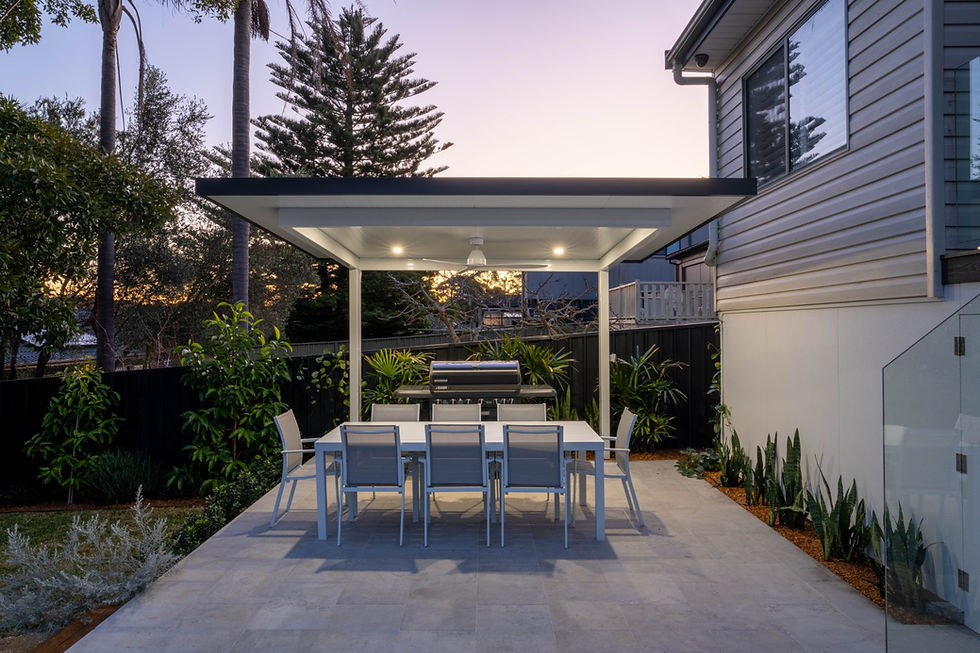
When most people see a Luxe Cantilever® for the first time, the reaction is usually some version of: that shouldn't be possible. A full-size insulated roof, up to six metres wide and six metres deep held up by just two posts along one edge, with nothing supporting the other side. No corner posts. No bracing. Just open space.
It looks like it's defying gravity. It isn't, but the engineering behind it is genuinely interesting!

What is a cantilever: the basic physics
In a cantilever pergola, the roof structure extends horizontally from the two posts, projecting outward without front posts to carry the load. The forces that would normally be distributed across four or more posts are instead concentrated into two, which means those two posts, their connections, and their foundations have to work significantly harder than in a conventional pergola.
This is why most "cantilever" structures you'll find are either small in span, not insulated (and therefore much lighter), or structurally questionable. A fully insulated cantilever pergola of practical size requires serious engineering, not a standard design that someone has adapted. We see many installs out and about that haven't been well engineered - a problem you'll only understand the next time a big storm hits!
Why two posts instead of four?
In a traditional four-post pergola, the load path is straightforward. The roof weight pushes down, is carried by the beams, transferred to the four posts, and distributed into the footings below. The structure is in compression throughout each post carrying roughly a quarter of the roof load.
A two-post cantilever works differently. The overhanging section of the roof creates a bending moment, a rotational force that tries to tip the structure forward. The further the roof extends beyond the posts, the greater this rotational force becomes. To counteract it, the posts and their foundations have to resist not just downward compression but rotational force which is a fundamentally more demanding structural requirement.
This is why the connection between the roof structure and the posts is the most critical element of any cantilever design. It has to transfer both vertical load and rotational force without movement or failure. In the Luxe Cantilever®, this connection is the subject of both our registered design protection and our patent pending application, it's the engineering detail that makes the spans possible and it's what separates a properly engineered cantilever from an improvised one.

How the Luxe Cantilever® is secured to the ground
Concrete Piers
For all Luxe Cantilever® models except the Lite, concrete piers are used to anchor the structure into the ground. Pier depth is determined by the size of your cantilever and the soil conditions at your specific site.
In typical conditions, our pier depth can vary significantly depending on the model and size of the roof. The reason for the variation comes down to soil bearing capacity. Clay soils, which are common across much of Australia, tend to have reasonable bearing capacity and provide good lateral resistance, meaning shallower piers can often suffice. Sandy soils have lower bearing capacity and offer less resistance to the rotational forces a cantilever generates, so they tend to require a deeper, more substantial pier.
This is why we always assess the specific site conditions before confirming pier specifications. A pier that's adequate for a clay soil in the Sutherland Shire may not be adequate for a cantilever pergola at a sandy site on the Gold Coast. Getting this wrong doesn't just compromise aesthetics, it compromises structural safety.
The piers are designed to handle two types of force simultaneously: the downward compression from the roof load, and the lateral and rotational forces generated by the cantilever overhang and wind loading. Both have to be accounted for in the design.

The Lite: direct slab fixing
The Luxe Cantilever® Lite is a light-weight aluminium cantilever pergola designed for a simpler installation approach. Due to its reduced weight and size, it can be bolted directly into an existing 150mm+ reinforced concrete slab making it significantly faster and simpler to install, and the reason it suits smaller, more accessible projects like courtyard areas, pool surrounds, and compact entertaining spaces.
The critical requirement is that the slab must be reinforced concrete, not plain concrete. Reinforced slabs, where steel reinforcement mesh or bar is embedded in the concrete, have the tensile capacity to handle the fixing loads safely, whereas with plain concrete slabs, bolts can pull through or crack the slab under the load.
Whether your existing slab is suitable isn't something that can be determined from a photo or a phone call. It requires a site assessment, which our authorised installers carry out as part of the quoting process.
Wind loading and certification
Any outdoor structure in Australia needs to be designed to handle wind loading, determined specifically to your location. Coastal areas, elevated sites, and northern Queensland all have different wind speed requirements than sheltered suburban backyards in southern states.
The Luxe Cantilever® Original and Max are formally load tested and wind tested to an N2 wind rating, in accordance with Australian Standards. This isn't a marketing claim, it's a certification that the structure has been tested to perform under defined wind conditions without structural failure.
For a cantilever pergola, wind loading is particularly important. In addition to the downward load from the roof weight, wind creates uplift forces that try to lift the roof rather than push it down. A cantilever is more exposed to uplift than a four-post pergola because the unsupported edge has no restraint from below. The engineering has to account for both the downward load in still conditions and the uplift forces under wind loading, and the structure has to perform safely under both.
It's worth noting that wind rating requirements in your area should be confirmed with your authorised installer during the quoting process. In coastal areas, high-altitude sites, and tropical regions, additional considerations may apply.

Not all cantilever pergolas are the same
If you've been researching cantilever pergolas online, you've probably come across a range of options, including non-insulated, slatted or louvred designs that use a similar two-post principle. Let's look at what you're actually comparing so you can compare apples to apples.
Many cantilever structures on the market use a single-sheet polycarbonate or metal roof with minimal weight, minimal engineering requirements and concomitant limitations such as no insulation and poor thermal comfort. This lighter roofing is often installed on a flimsy frame with exposed bolts and unattractive connections that's just not built to last. They're cheaper to install initially, but there are a few trade-offs to be aware of.
They look cheap, which can compromise the aesthetic of your home
They limit the value your pergola offers your family in terms of year-round comfort compared to an insulated roof. Ever tried baking under one of those metal roofs in a hot Aussie summer?
They're usually not as durable - the thickness of the aluminium and the powder coating are determined for price, not durability, which may mean that in ten years time you have one that looks as good as new, and one that looks old and weathered, dented and chipped.
The Luxe Cantilever® uses a fully insulated Versiclad roof panel, the same system used in high-quality enclosed patios and pergolas. This means a weathertight roof that keeps rain out completely, thermal insulation that keeps the space cooler in summer and warmer in winter, and a pre-finished ceiling that looks like a proper architectural addition to your home rather than a shade sail on a frame.
The trade-off is weight. Insulated panels are substantially heavier than slats, which is precisely why the engineering has to work harder, and why the connection system, the pier specifications, and the structural certification of the Luxe Cantilever® are not comparable to anything else on the market.

Why "engineering" isn't just a marketing word
The outdoor structures industry uses the word "engineered" loosely. Often times it means little more than "designed by someone." When we say the Luxe Cantilever® is 'fully engineered' we mean something much more rigorous: the structure has been formally designed to Australian Standards, load tested, wind tested, and certified. The design is protected by Australian Registered Design No. 202318723, and the structural system is the subject of a patent pending application.
Why does a cantilever pergola need to be engineered?
Your Luxe Cantilever being properly engineered has real-world, practical implications.
Wherever you're building, it's nice to know that you're doing it once and doing it right. Your Luxe Cantilever is built for strength and durability so you can build it once and forget about it.
If you're building in a heritage conservation area, applying for a CDC or DA, or adding to a property you intend to sell though, a structure with formal engineering certification and design protection is far easier to get approved and far less likely to create problems at the point of sale than one that isn't.
What This Means for Your Project
The good news is that you don't need to understand soil bearing capacity or bending points, all of this engineering complexity is handled entirely by your authorised installer.
Once you've decided you want to go ahead with a Luxe Cantilever, your installer will assess the site, confirm the right model for your space, and take care of everything from pier specifications through to council approval if it's required. Most homeowners find the process significantly simpler than they expected, particularly compared to a full renovation or extension.
The result is a structure that's been engineered, tested, and installed correctly from the ground up. One that will look as good in fifteen years as it does on day one, perform in all weather, and add value to your property.
Find an Authorised Installer Near You
Ready to see what a Luxe Cantilever® would look like in your space? Find your nearest authorised installer and book a free on-site consultation.


Comments